
Tesla Model Y: Pull Onto Flatbed Truck From Front
NOTE: If Model Y has no low voltage power, you need an external low voltage power supply to open the hood or use the touchscreen.
CAUTION: To avoid damage, only pull the vehicle onto a flatbed truck using a properly-installed tow eye. Using the chassis, frame, or suspension components to pull the vehicle can result in damage.
1. Locate the tow eye. The tow eye is located in the front trunk.
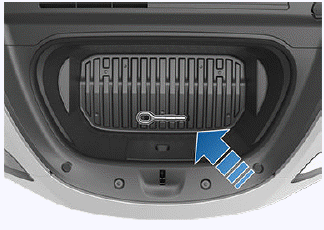
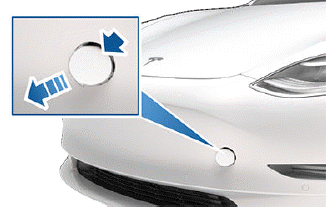
2. To remove the tow eye cover, insert a small, flat screwdriver into the top and bottom slots, release the snaps and pull the cover towards you.
NOTE: The front tow eye cover is connected to the vehicle's black negative (-) terminal.
3. Fully insert the tow eye into the opening, then turn it counter-clockwise until securely fastened.
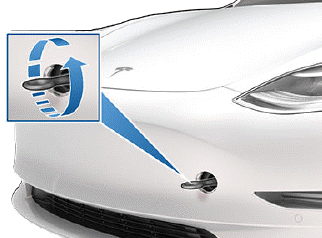
4. Attach the winch cable to the tow eye.
CAUTION: Before pulling, make sure the tow eye is securely tightened.
5. Activate Transport Mode.
6. Pull Model Y slowly onto the flatbed truck.
READ NEXT:
 Pull Onto Flatbed Truck From Rear
NOTE: If Model Y has no low voltage power, you need an external low
voltage power supply to open the hood or use the touchscreen.
CAUTION: To avoid damage, only pull the vehicle
onto a flatbed truck
Jump Starting the Low Voltage Battery
If jump starting Model Y using another vehicle, refer to that vehicle
manufacturer's instructions. The following instructions assume you are using an
external low voltage power supply (such as a por
SEE MORE:
Before Using Summon
Before operating Summon, use the touchscreen to
enable it and customize how you want it to work. Touch
Controls > Autopilot > Customize Summon and adjust
the following settings to suit your preferences:
Bumper Clearance: Set the distance that you want
Summon to stop from a detected obje
Opening and Closing
Press down on a switch to lower the associated window.
Window switches operate at two levels:
To lower a window fully, press the switch all the way
down and immediately release.
To lower a window partially, press the switch gently
and release when the window is where you want it.
Similarl
