
Tesla Model Y: Closing
The Model Y hood is not heavy enough to latch under its own weight and applying pressure on the front edge or center of the hood can cause damage.
To properly close the hood:
1. Lower the hood until the striker touches the latches.
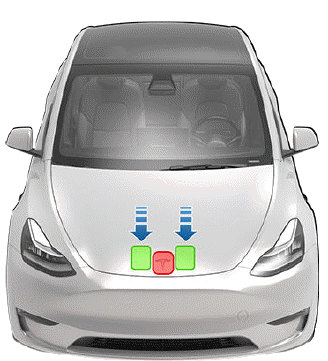
2. Place both hands on the front of the hood in the areas shown (in green), then press down firmly to engage the latches.
3. Carefully try to lift the front edge of the hood to ensure that it is fully closed.
CAUTION: To prevent damage:
- Apply pressure only to the green areas shown. Applying pressure to the red areas can cause damage.
- Do not close the hood with one hand. Doing so applies concentrated force in one area and can result in a dent or crease.
- Do not apply pressure to the front edge of the hood. Doing so can crease the edge.
- Do not slam or drop the hood.
- To avoid scratches, don't have anything in your hands (keys). Jewelry can also cause scratches.
WARNING: Before driving, you must ensure that the hood is securely latched in the fully closed position by carefully trying to lift the front edge of the hood upward and confirming there is no movement. If the front trunk is not closed, a message displays on the touchscreen that you cannot shift the vehicle out of Park until the front trunk is securely closed.
The front trunk locks when:
- You lock Model Y using the touchscreen, key or mobile app.
- You leave Model Y carrying your key (if Walk-Away Door Lock is turned on).
- Valet mode is active (see Valet Mode).
READ NEXT:
 Interior Emergency Release
An illuminated interior release button inside the front
trunk allows a person locked inside to get out.
Press the interior release button to open the front trunk,
then push up on the hood.
NOTE: T
Center Console
In addition to housing an RFID transmitter that reads key
fobs and key cards (see Keys), the center
console includes cup holders, two storage
compartments, wireless phone chargers, and a rear
touc
SEE MORE:
Jump Starting the Low Voltage Battery
If jump starting Model Y using another vehicle, refer to that vehicle
manufacturer's instructions. The following instructions assume you are using an
external low voltage power supply (such as a portable jump starter).
To determine whether your vehicle is equipped with a Lead-Acid or Lithium-Ion
Lane Changes
Navigate on Autopilot changes lanes to either prepare
Model Y for an upcoming off-ramp, to increase your
driving speed (not to exceed your set cruising speed), or
to move Model Y out of a passing lane when you are not
actively passing other road users. A message displays at
the top of the map's
