
Tesla Model Y: Adjusting Liftgate Opening Height
You can adjust the opening height of the liftgate to make it easier to reach or to avoid low-hanging ceilings or objects (for example, a garage door or light):
1. Open the trunk, then manually lower or raise the liftgate to the desired opening height.
2. Press and hold the button on the underside of the liftgate for three seconds until you hear a confirmation chime.
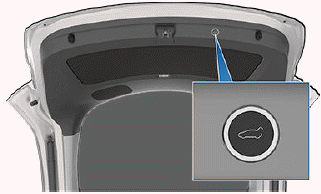
3. Confirm that you have set it to the desired height by closing the liftgate, then reopening it.
CAUTION: Depending on configuration (such as suspension height or wheel selection), your vehicle's liftgate can open up to approximately 7.5 feet (2.3 meters) high. Adjust the liftgate height to prevent it from coming into contact with low ceilings or other objects.
Closing
To close the liftgate, do one of the following:
- Touch the associated Close button on the touchscreen.
- Double-click the rear trunk button on the key fob.
- Press the switch located on the underside of the liftgate.
If the liftgate senses an obstruction when closing, it stops moving and chimes two times. Remove the obstruction and try closing it again.
READ NEXT:
 Accessing the Cargo Area
To access the cargo area inside the rear trunk, pull up the strap at the rear of
the cargo cover. You can then fold the cargo cover forward or remove it from
Model Y.
Secure all cargo before movin
Opening
To open the front trunk, ensure Model Y is in Park, and
then do one of the following before pulling the hood
open:
Touch the associated Open icon on the touchscreen.
Double-click the front trunk
SEE MORE:
During Charging
During charging, the charge port light pulses green, and
the touchscreen displays real-time charging status. The
frequency at which the green charge port light pulses
slows down as the charge level approaches full. When
charging is complete, the light stops pulsing and is solid
green.
NOTE: If
Adjusting Front Seats
Move seat forward/backward and adjust the seat's
height and tilt angle up/down.
Adjust backrest.
Adjust lumbar support.
WARNING: Before adjusting a front seat, check
that the area around the seat is free of obstacles
(people and objects).
WARNING: Do not adjust seats while driving.
Doin
